
13th HTAsiaLink 2026 Conference—Call for Abstract Submissions



- Last updated:2026-04-22
- Count Views:5912
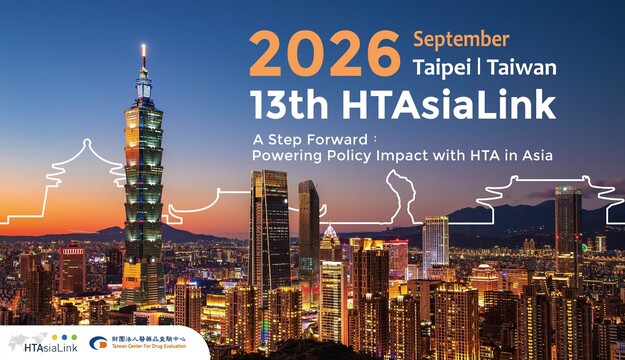
Conference Theme
A Step Forward – Powering Policy Impact with HTA in Asia
HTAsiaLink 2026 Conference Website is Now Live!
Visit now for registration, updates, and abstract submission → https://www.htasialink2026.org/
Join us from 1 to 4 September, 2026 for the 13th HTAsiaLink Conference, where HTA experts, policymakers, and researchers from across Asia come together to advance policy impact through knowledge and experience sharing. This year’s theme highlights steady progress—step by step—toward stronger systems, deeper evidence, and more responsive decisions. Together, we’re shaping a more impactful future for HTA in Asia.
Event date: 1 to 4 September, 2026
(1 September: Pre-Conference Day; 2-4 September: Main Conference)
Location: Taipei International Convention Center (TICC) (台北國際會議中心), Taipei, Taiwan
Address: No. 1, Section 5, Xinyi Rd, Xinyi District, Taipei City, 110, Taiwan.
Plenary 1 – Facing Uncertainty Together: Shared HTA Challenges and Diverse Approaches
The session will explore how HTA respond to uncertainty across different contexts and stages of policy and practice, highlighting challenges encountered in implemented policies and programs and the solutions applied to address them. Discussions may include, for example, experiences in assessing innovative technologies, accelerating market access, or strategies to integrate equity considerations into policy and practice.
Plenary 2 – Evidence Evolving: Rethinking What Works in Real-World Complexities
This session will focus on the practical implementation of Real-World Evidence (RWE), addressing challenges encountered in practice and the approaches to overcome them. Topics may cover RWE methodologies, data governance, and policy applications of RWE, such as supporting reimbursement decisions, conditional listing, or Health Technology Reassessment (HTR), and its applications across different health technologies.
Plenary 3 – One Size Doesn’t Fit All: The Future of HTA in a Dynamic Technology Era
This session will explore how HTA can adapt to the fast-changing landscape of health technologies. Discussions may include the integration of AI-driven tools for HTA, and approaches for evaluating digital health technologies. The session may also touch on environmental sustainability, cross-sector collaboration, and regional harmonization, all aimed at driving tangible policy change and strengthen the role of HTA in health systems.
Important Dates
Abstract Submission Deadline: 24 April 2026
Notification of Abstract Acceptance: May 2026
Abstract Submission Process
Step 1 – Check Eligibility
Ensure you are affiliated with an HTAsiaLink member or associate member organisations. Please consult the HTAsiaLink Organizational Members List. (If not eligible, kindly follow the Submission Guidelines to apply for individual membership by emailing sec@htasialink2026.org at the time of abstract submission.)
Step 2 – Prepare Your Abstract
Prepare your abstract using the template provided in the Submission Guidelines and make sure it follows the instructions outlined in the guidelines.
Step 3 – Login or Create Your Account
Your email address will be used as your username and you will be asked to create a password. Please be aware that the information you provide when creating your account will be automatically carried over to the registration process and will be used for official Letters of Acceptance, Letters of Invitation, and Conference Programmes. Therefore, please ensure correct spelling of names, affiliated institutions, and so forth.
Abstract Submission System: https://www.htasialink2026.org/login
Step 4 – Submit Your Abstract
Fill out the required information and submit your abstract (maximum 300 words) via the online submission system.
Step 5 – Check Email for Confirmation
Check your email for the submission confirmation.
There are 3 tracks available for abstract submission in HTAsiaLink Conference 2026. Authors should select the most suitable track to submit your abstract(s).
Track 1:
Economic Evaluation
Topic areas include:
- Cost studies (illness/resource use)
- Cost comparison
- Budget impact analysis
- Thresholds & opportunity cost
- Trial-based economic evaluation
- Indirect health costs
- Value of information
- Novel & social elements of value1
Track 2:
Health Services Research
Health services research is the multidisciplinary field of scientific investigation that studies how:
- Social factors
- Financing systems
- Organisational structures and processes
- Health technologies
- Personal behaviours
affect access to health care, the quality and cost of health care, and ultimately our health and well-being.2
Topic areas include policy analysis, qualitative studies or mixed methods.
Track 3:
Others
This track encompasses all research areas not specifically covered in Track 1 or 2. It can include diverse health-related studies, including but not limited to:
- Evidence synthesis: systematic reviews, meta-analysis, network meta-analysis, scoping reviews
- Data science: observational studies, real-world evidence
1 ISPOR. About Economic Evaluation. ISPOR. Accessed Nov 7, 2024.
https://www.ispor.org/heor-resources/heor-by-topic-new/economic-evaluation
2 Lohr KN, Steinwachs DM. Health services research: an evolving definition of the field. Health Serv Res. 2002;37(1):7-9.
! Not yet a HTAsiaLink member? If you are from a non-profit organization and are not affiliated with an HTAsiaLink member or associate member organizations, we warmly encourage you to apply for individual membership. This is a valuable opportunity to connect with a regional network of HTA professionals, engage in shared learning, and contribute to ongoing policy dialogue beyond the conference. To apply, please download the individual membership application form below and submit the completed form together with your CV or resume to sec@htasialink2026.org. It is to be noted that persons with affiliation to the for-profit industry will not be accepted to the network.
We warmly encourage you to join the HTAsiaLink community and be part of the conversation shaping the future of HTA in Asia.
If you have any questions, please contact us at: sec@htasialink2026.org
File download
| 序號 | 名稱 | 檔案類型 | 檔案大小 |
|---|---|---|---|
| 1 | HTAsiaLink 2026 Abstract Submission Guidelines |
|
488.9KB |
| 2 | htasialink-2026-abstract-submission---track-X_Author |
|
38.9KB |
| 3 | HTAsiaLink Organizational Members List |
|
137.8KB |
| 4 | HTAsiaLink By-Laws |
|
108.5KB |
| 5 | HTAsiaLink individual membership application_[Your Full Name] |
|
19KB |